LAR behind prison walls – when medicine becomes currency
News tip sent to Bergens Tidende: . This is the email’s sent date, not the publication date of this post.
Source: My separate news tip to Bergens Tidende, sent on 11 August 2026.
This is a new, separate tip, distinct from the tip I sent on 7 August 2026 about digital legal safeguards in prison.
When I arrived at Bergen Prison in March 2023, I had never used heroin and had not been dependent on strong opioids. My first sentence lasted nine months; I was released in November that year. Methadone and Subutex/buprenorphine were among the first things other prisoners offered me. I got it almost free. There was so much of it. Everyone who used it had it.
I was told that the medicines were “clean” because they came from LAR, that they could be snorted, that the effect was pleasant, and that they made the time in prison pass more quickly.
I started using Subutex and felt that I became dependent within a very short time – about a week. I used it daily for around three months.
When I stopped, I suffered extremely severe withdrawal, with intense pain in my body and serious physical distress. It was one of the hardest things I have been through.
When I was imprisoned again in August 2024, I encountered the same supply, almost free. In October 2024 I cut everything out and turned my life around, for myself and, above all, for my daughter. I have not used it since. I am still here, on C7.
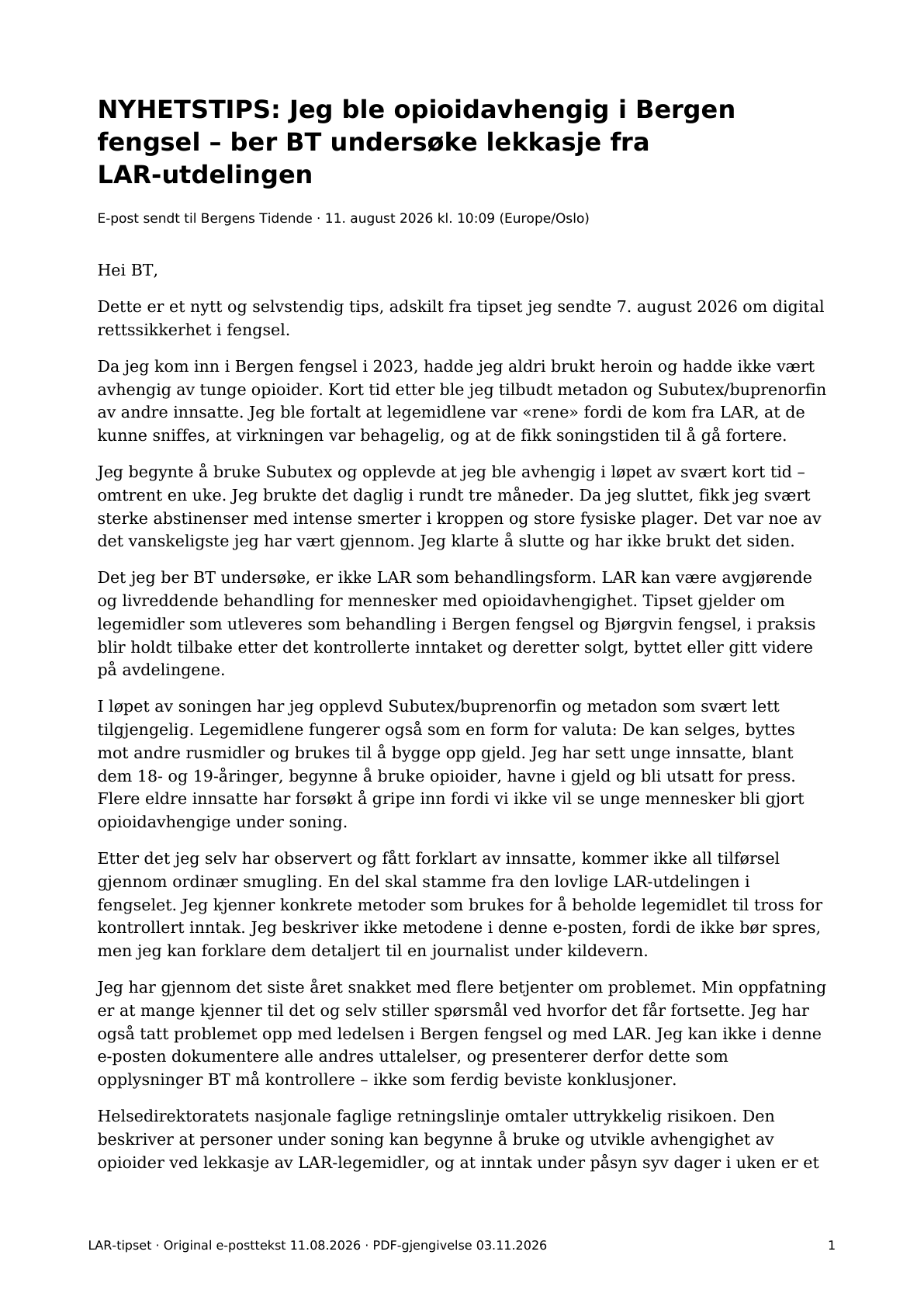
What I am asking BT to investigate is not LAR as a form of treatment. LAR can be crucial, life-saving treatment for people with opioid dependence. The tip concerns whether medicines dispensed as treatment in Bergen Prison and Bjørgvin Prison are, in practice, held back after supervised intake and then sold, traded or given to others in the prison wings.
During my sentence, I have found Subutex/buprenorphine and methadone very easy to obtain. The medicines also function as a form of currency: they can be sold, traded for other drugs and used to build up debt.
I have seen young prisoners, including 18- and 19-year-olds, start using opioids, fall into debt and be subjected to pressure. Several older prisoners have tried to intervene because we do not want to see young people made dependent on opioids while serving their sentences.
Based on what I have observed myself and what prisoners have explained to me, not all of the supply comes through ordinary smuggling. Some of it is said to come from the lawful dispensing of LAR medicines in the prison.
I know specific methods used to retain the medicine despite supervised intake. I am not describing the methods in this text, because they should not be spread, but I can explain them in detail to a journalist with source confidentiality.
Over the past year, I have spoken to several prison officers about the problem. My impression is that many know about it and themselves question why it is allowed to continue. I have also raised the problem with the management of Bergen Prison and with LAR.
I cannot document everyone else’s statements in this text, and therefore present this as information for BT to check – not as conclusions that have already been proven.
The Norwegian Directorate of Health’s national professional guideline explicitly discusses the risk. It describes how people serving prison sentences can start using opioids and develop dependence when LAR medicines are diverted, and how supervised intake seven days a week is a measure intended to prevent diversion in prison.
The central question, then, is whether the formal system of supervision actually works at Bergen and Bjørgvin prisons.
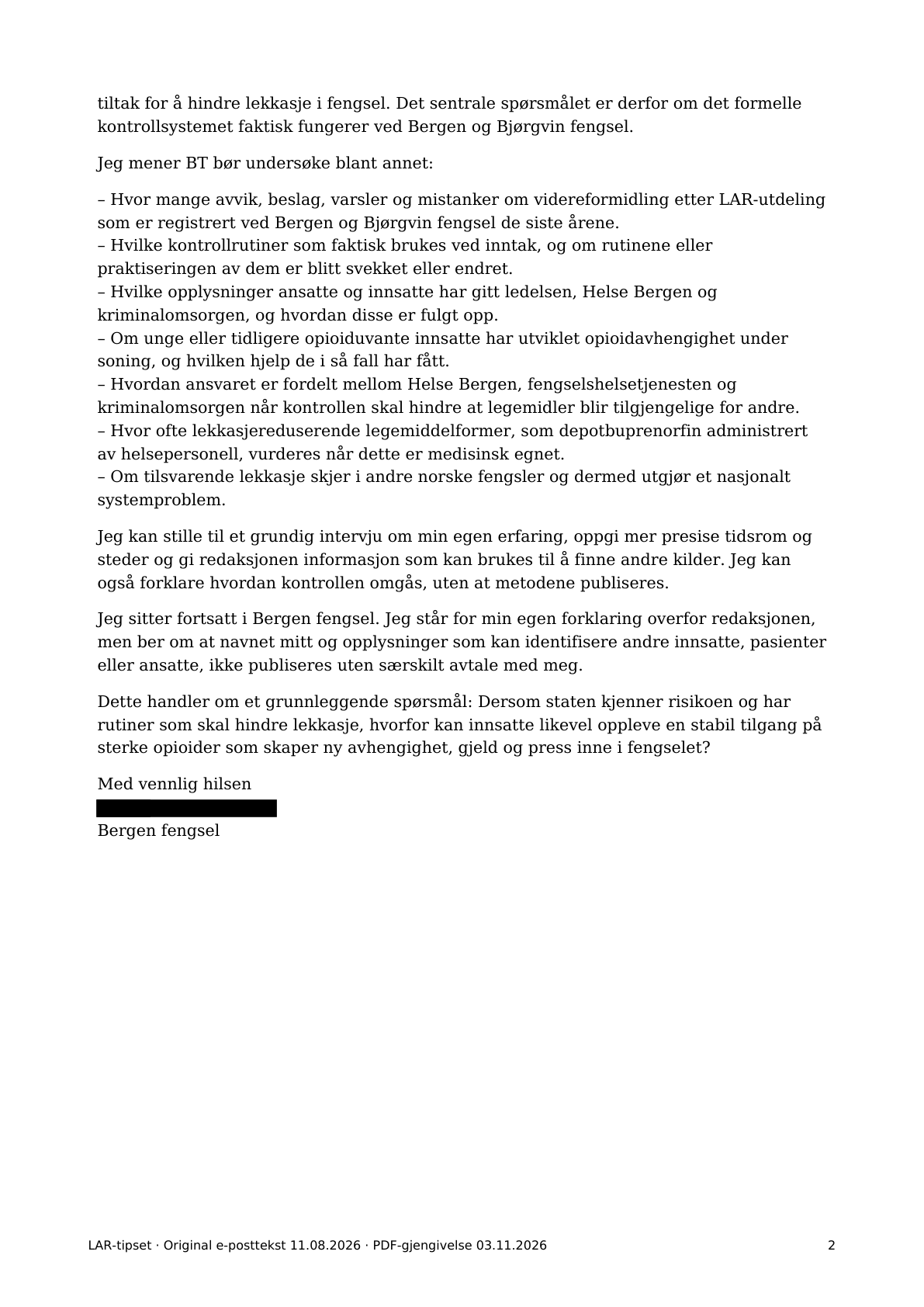
I believe BT should investigate, among other things:
- How many incidents, seizures, reports and suspicions of medicines being passed on after LAR dispensing have been recorded at Bergen and Bjørgvin prisons in recent years.
- What supervision procedures are actually used when medicines are taken, and whether the procedures or the way they are applied have been weakened or changed.
- What information staff and prisoners have given to management, Helse Bergen and the Norwegian Correctional Service, and how this has been followed up.
- Whether young prisoners or prisoners who had not previously used opioids have developed opioid dependence during their sentences, and what help they have received if so.
- How responsibility is divided between Helse Bergen, the prison health service and the Norwegian Correctional Service when supervision is supposed to prevent medicines from becoming available to others.
- How often forms of medicine that reduce the risk of diversion, such as long-acting buprenorphine administered by healthcare personnel, are considered when medically suitable.
- Whether similar diversion occurs in other Norwegian prisons and thus constitutes a national systemic problem.
I can take part in an in-depth interview about my own experience, give more precise periods and locations, and give the newsroom information that can be used to find other sources. I can also explain how the supervision is circumvented, without the methods being published.
I am still in Bergen Prison. I stand by my own account to the newsroom, but ask that my name and information that could identify other prisoners, patients or staff not be published without a separate agreement with me.
This is about a fundamental question: if the state knows the risk and has procedures intended to prevent diversion, why can prisoners still experience a steady supply of strong opioids that creates new dependence, debt and pressure inside the prison?
About this source
The complete redacted tip sent to Bergens Tidende on 11 August 2026 is displayed below. It is a rendering of the sent email, not an official decision. A newsroom response has not been verified here.
Image: An AI-generated illustration offering social criticism. It does not document any individual, particular dispensing event or cause of death.
Sources
- Norwegian Directorate of Health: Dispensing arrangements in LAR, last professional revision stated as 17 April 2024. Specifically addresses imprisonment, risk to third parties and supervised intake.
- Norwegian Directorate of Health: Treatment of opioid dependence, including the summarised research on mortality and treatment benefits.
- Norwegian Directorate of Health and Directorate of the Norwegian Correctional Service: Joint letter on responsibilities and tasks for LAR, 10 March 2021.
- Lovdata: Execution of Sentences Act, particularly sections 2, 3, 7, 28 and 38. Historical events must be assessed under the rules in force at the time.
The original tip sent to Bergens Tidende
My tip, sent on 11 August 2026. The PDF faithfully reproduces the sent email with identifying details redacted. This is my tip, not an official decision.
Open the complete redacted tip as a PDF