The author’s account and criticism. Allegations about intent and legal breaches are the author’s assessments, not court findings. AI-assisted translation; the Norwegian source governs quotations and documentary details.
Roald Dahl’s witches have titles in here. Lawyer. Adviser. Decision-maker. They do not need to enter your cell to hurt you. They can sit in an office and write. Week after week, year after year. An intervention in your life, another refusal, another piece of your child’s childhood disappearing while the case is processed.
You can appeal. It says so. That sentence is somehow supposed to make everything else bearable. You appeal, months pass, and the intervention continues to take its toll. Six months later, the case may still be under consideration. Nobody has put aside the day you should have spent with your child. It has been used up.
What does the lawyer at Bergen Prison know about why I used drugs more than two years ago? About the separation, the financial ruin? The land and house I had built on the other side of the world, for our future, and then finding myself outside the life my ex-wife had decided to shut me out of. That entire collapse is supposed to fit inside a history of substance use. A phrase allowed to travel onwards, while everything I have done since has to fight for space.
More than twenty negative drug tests. ADHD medication. A statement from the chief physician. School. CRUX. Staff. The work I have put in, and my daughter as my motivation throughout it all. I have tried to show what my relationship with her does for me, why I want to live differently, what I am actually doing to make that happen. There are people around me who have seen it.
Then comes the assessment of risk, and I do not recognise the person described there.
She can write that there is a risk of further serious crime. She can give the past whatever weight she believes it should have, and push what I have built towards the margins. How am I supposed to fight that? How much must I document before it is allowed to change the picture? If the case is to be properly established, surely the evidence against the conclusion must be included too. Otherwise, collect as much paper as you like. You have merely filled the file around an answer you already had.
A stroke of a pen can overturn what I have spent school, treatment and every day of my sentence trying to build. Her working day continues. I remain inside the life she has written in.
Power corrupts. Absolute power corrupts absolutely. I understand that sentence with a different part of my body now.
I have spoken out too. Challenged the Correctional Service, written about what lies under the carpet, let journalists in. I believe what then happens to me is deliberate retaliation. I believe you know what you are doing when you make me desperate and then use that desperation as evidence that you were right. A prisoner who makes noise outside must not make other prisoners believe it is safe to do the same. If you can hit him as he approaches two-thirds of his sentence, people notice. Everyone can see what opening his mouth cost him.
And you know where to hit me. The prison wrote it itself when transfer to lower security was being considered: how important my daughter is to me. You found my motivation when you needed to justify a step forward. Later, the paths to her are precisely what gets blocked.
The documents for the child-welfare case. The email containing what I need for the hearing. Help from a lawyer. Access to the computer. The deadlines. All these apparently small matters end in the same place for me: the opportunity to be a father, and to remain one after serving my sentence.
So yes, I get angry. I get desperate. I ask again and explain again, and eventually my voice is no longer calm. What do you expect of a father when this is what you are keeping beyond his reach?
Then read what survives into the description of him. Loud. Angry. Frustrated. Called someone useless. There is the reaction, neatly detached from what brought it about. It is allowed to stand alone and look dangerous. The reader meets me at the moment I cannot stand it any longer. Everything before that disappears.
I look for the staff’s part in my decisions. Where is the mistake they made? Where is the delay, the rejection, the document I could not get hold of? This is also what I am trying to address when I write about eight days of schooling before someone can begin working in a prison. A very young trainee or temporary employee can stand there with that short training behind him, yet his description can carry the weight of an established truth. Mine has to negotiate the entire obstacle course before it is even heard.
The lawyer protects the description. The description gives the lawyer something to point to. The intervention can proceed. Then comes life afterwards: powerlessness, isolation, the progress lost in an instant, the appeal you must get through before the short deadline expires. Perhaps the decision arrives too late. Perhaps you sit waiting for the access you need to answer. You use all your strength trying to do what those same people require you to do, through the obstacles they themselves administer.
If you manage it, you can receive a refusal and have the case forwarded. More months. Perhaps years before you have completed the process. Meanwhile, you know what you are protesting against. You were there. You know it did not happen that way. Every time you read the same account again, you have to feel it still controlling your life.
Eventually, you react to this as well. It becomes too much. Then they have a new reaction to use. It can be placed alongside the first and made to look like the confirmation they lacked.
That is the self-fulfilling cruelty I am trying to make you see. You pressure a person until he reacts, take the reaction out of context and use it to justify more pressure. Afterwards, you can point out that the person keeps reacting. What a convenient way to be right.
I call it torture when I describe what this does to me. Anyone who reads only my words and thinks they are too strong must also read what those words are trying to contain. Go back to the child. To the deadline. To the third week without access to what you need. You are not discussing a principle over coffee. You are watching an opportunity to defend your relationship with your daughter slip away.
Then you hear about the laws and rules of a prison. About other people needing help too. As though that were what you had failed to understand.
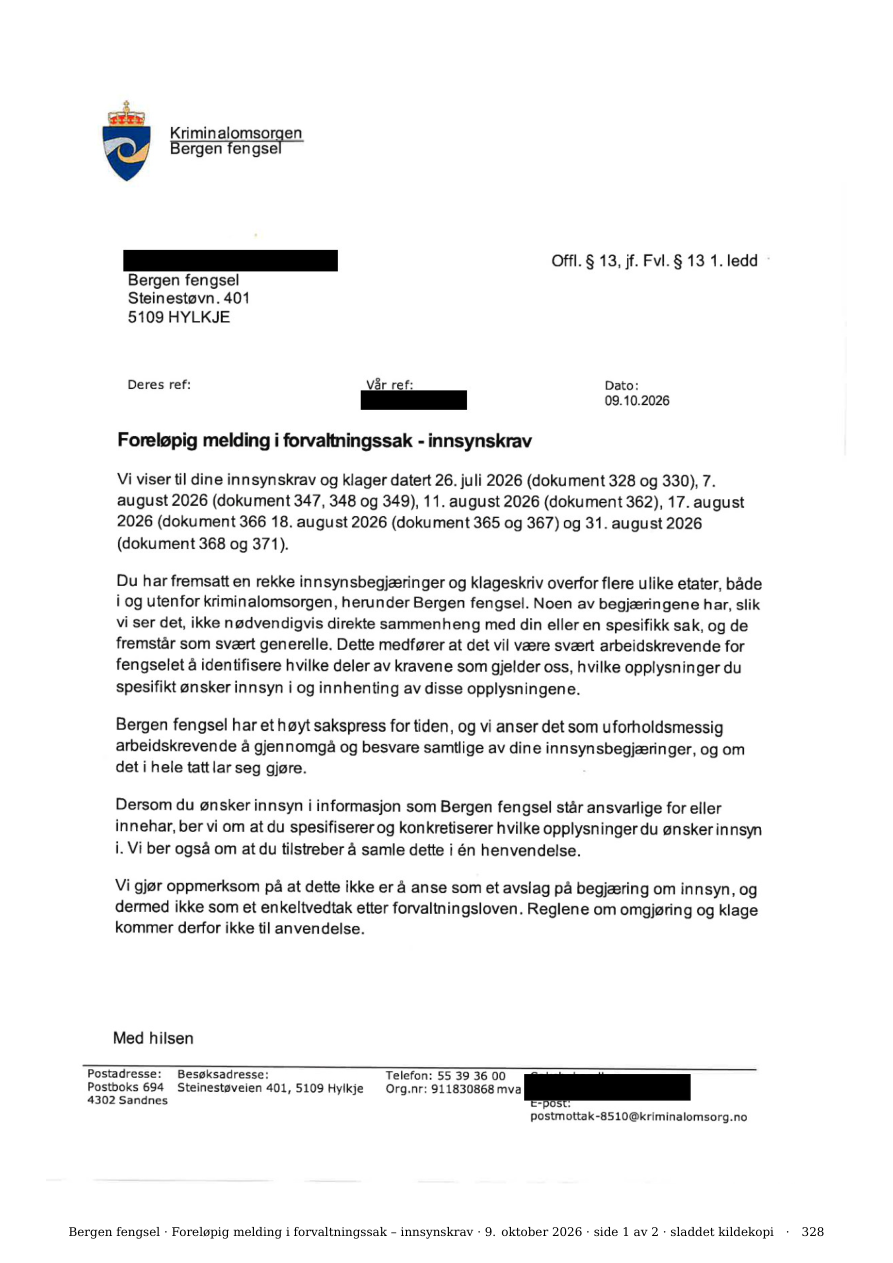
The letter about access to records · 9 October 2026
“Bergen Prison is currently experiencing a high caseload,” says the letter dated 9 October. The prison writes that it considers it “disproportionately labour-intensive to review and answer all your requests for access, if that is even possible”. It asks me to specify which information I want and collect it in one enquiry. The letter refers back to requests and appeals from July and August.
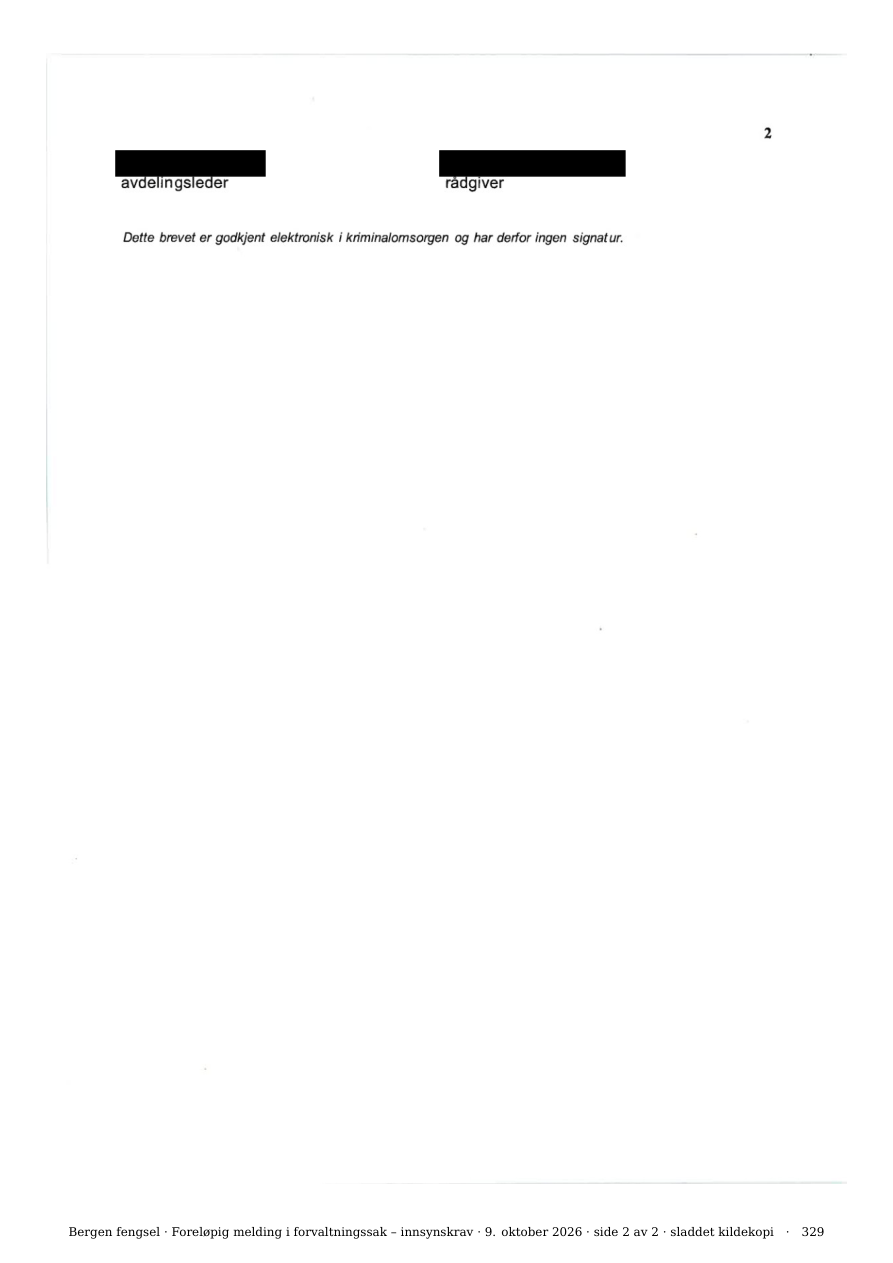
Document note: The complete letter, “Preliminary notification in an administrative case – requests for access”, dated 9 October 2026, is reproduced below. The prison explicitly describes the letter as a preliminary notification, not a refusal or an individual administrative decision. That is the sender’s classification; reproducing it does not resolve legal questions about procedure, access or review. Source: 0838_001.pdf, pages 1–2. The other pages in the scanned bundle concern other documents and working instructions. A particular historical appeal submitted in response to this letter has not been confirmed in the material.
Write down the whole situation instead. Write that he was trying to obtain documents for the hearing. Write what he was denied, and for how long. Include that before you describe how angry he became. Let whoever is assessing him read both parts. I think you know how different he would look then.
This is where the digital struggle comes in. For six months, I have used artificial intelligence to try to bring order to this. Read decisions alongside one another. Find a justification that changes. Trace an assertion backwards. See whether a cited legal provision actually fits, and whether a justification has been repaired afterwards. Get help with an appeal, an application for legal aid, a letter I otherwise could not have moved out of my head and onto paper.
But there too, I have to start again. Explain the same things over and over. The tool loses context, cannot find its way back to the files and omits important information when a new version is written. A document may be phrased as though its reader already knows all the previous rounds. But the person opening the letter at NAV Control, or the lawyer reading it for the first time, does not know which earlier documents the machine is referring to. I have to make it understand. Again.
My periods of leave should have given me rest and time with my daughter. Instead, I have spent many, many hours watching to make sure a task actually gets done. I am so afraid that what is necessary will not be finished before I have to return. I need the documents to achieve a little legal balance, to become free and be there for her. So I sit supervising the work that is supposed to give me more time with my child, while my time with her passes.
Suddenly, an ordinary prisoner could begin meeting the lawyer with something other than a desperate protest. He could point to the wording. Refer to the date. Ask where the information came from. Demand that the law used against him should also be followed by those using it.
That changes the balance of power. That is why I believe KOMPASS must be investigated as more than a question of which websites we are allowed to open.
Where we were, what remained were locked tabs to services such as Digipost, NAV and the Tax Administration. The tool I used to challenge interventions in my life was gone. As I remember the conversation, the senior officer said that my appeals were bringing the system to a standstill, that I could not sit there sending appeals directly to KDI. My computer access was taken away and withheld for three weeks, until KOMPASS arrived.
Take that sequence seriously. I appeal. I am told that the appeals are the problem. Access disappears. Then a system arrives in which I no longer have the tool that made the appeals possible.
Am I supposed to believe this is not about stopping me?
To me, it is obvious that access to AI threatens the old peace and quiet at work. A prisoner who can keep track of a hundred documents is harder to dismiss than one who loses the thread on page three. Someone who can compare ten justifications can find a pattern he would never have noticed while sitting alone with one appeal and a deadline already running.
The same applies to the equipment. Computers from 2011, failing digital access, priorities nobody explains satisfactorily. The tools could help us ask where the funds go, who decided what and who checks conflicts of interest. If there is misuse of money or authority, it should be investigated. The whole point is that we need access to ask such questions with the documents in front of us.
Instead, they can take the tool. They still have the legal language, the archive and their working day, while we must fill in whatever we can through the small opening left to us. I call it a legal dictatorship when one side controls both the decision and the other side’s opportunity to challenge it.
Think further. A hundred prisoners. The same prison. The same lawyer. A year’s decisions placed side by side. What would we find? How often does the cause disappear while the reaction remains? How often does the legal basis or explanation change? How many interventions run their course before anyone has time to examine the appeal?
An individual man can be told he is simply difficult. A hundred cases with the same pattern are harder to hide inside one man’s temperament.
This is what I want to work towards: a place where prisoners can get help with their documents and receive the appeals they need. Personal information must be protected, names and identifying details removed from material used to examine patterns. Whoever operates the site must not be able to snoop through people’s lives. The analysis should make it possible to see the practice, and to trace a finding back to the document it actually rests on.
I want there to be something a lawyer can work on, something a journalist can examine. If the material reveals systematic breaches, I want it brought to newsrooms. To those who can ask questions outside and demand answers. I want lawsuits and compensation to become real possibilities for people whose lives have been damaged, if the grounds are there.
Then it could become uncomfortable to have been so certain that a prisoner would never manage to understand his own case. Then staff too might have to answer for what they have done. Imagine what that does to a system accustomed to every person standing alone before it.
They can take my computer access. This technology is not going away. And I intend to use it to hold the documents steady, so they do not slip away while somebody tells a prettier story about what happened.
Read the decisions. Read the words. Read the interventions in one man’s attempt to preserve a normal relationship with his daughter. Look for the rotten, dark sludge left behind when you scrape away the polished language. Make up your own mind about the witches in Bergen and Bjørgvin.
I remember speaking to a law student at Jussbuss after he had read the reversal of my leave and the analysis I had received help with. What stayed with me was how little legal protection a prisoner has in facing the lawyer. And to me, the picture is this: prosecutor, investigator, police, defence lawyer, witness, jury, judge and executioner gathered on the same side of the desk. The lawyer as a god in a room where the prisoner can shout without anyone outside hearing him.
The prisoner becomes a “tyskertøs” — the derogatory label used for Norwegian women associated with German soldiers during the war. Stamped. Someone you can humiliate while others look away, because the label is supposed to explain why it is acceptable. That is how this grey area feels: you have rights on paper, but you cannot get them between yourself and what is being done to you.
This is what I want you to look for when you see the glossy image on television. The Correctional Service as a reality show, the helpful people, the reassuring story that someone is taking care of the difficult people so you do not have to. An idyllic town, with a locked door precisely where the camera stops following.
I call it brainwashing when the picture becomes so pretty that people stop asking questions. When a prisoner’s protest merely makes his role as the difficult inmate more convincing, while the person with power over him avoids having the justification examined.
That is why I present my story. Prisoner 260146. Prisons west of the law. You should be able to look behind the picture, into the documents, down into what actually happens to a person and his child.
I believe we must follow the money and the careers too. The funding. The salaries. The stripes on the shoulders. Favours and family connections where they exist. Ask who benefits from the machine running as it does, and who pays when it grinds the wrong way.
When I think of that distance, I see holiday cabins in Eikedal and a Porsche Cayenne on one side, and a child losing another day with her father on the other. It is a picture of a class divide in power: some can drive home from the consequences. Others are locked inside them.
Families, childhoods, prisoners: cannon fodder. Your relationship with your child as collateral damage while others advance their careers. That is the bottomless cynicism I am trying to show. A society cannot keep paying for people to be destroyed while congratulating itself because the bill is called rehabilitation.
What are we really learning here? What does it mean to become good at serving time?
The dog stops barking when you poke the stick into the cage.
There is my image. Eventually, it has learned that reacting does not help. It lies down. You get peace. And you can record that as progress.
A person can also learn to block out humiliation, mind his own business, not protest when treatment becomes degrading. Not get on the wrong side of someone with power. Refrain from telling the newspaper what he sees. Count the days and swallow what must be swallowed, so he does not have to stay longer than necessary.
But what have you really achieved if the calm comes from his having given up? What are you sending back into society then? A person filled with the frustration, hatred and powerlessness you never wanted to hear about? You can keep the reaction down while you hold the keys. That does not automatically make him a safer person.
Prisoners for reuse. That is what I accuse you of producing. You tear at what should anchor a person outside: his child, his relationships, his belief that doing something right can matter. You use the reaction to interventions to justify further interventions. Then you can send him out with less to hold on to and more to carry. If he falls, the gate is there. A new case, a new stay, more work for the same machine. And another person outside may have been harmed along the way.
That is why you should be angry too. The security you are promised must be built by people who one day need to live among you. If the practice crushes what should enable them to do that, you are the ones who will face the consequences afterwards. You pay for the meat grinder. You will have to live with what comes out.
I believe retaliation against those who speak out teaches the whole wing something. A refusal of parole can become an example everyone understands. Deprivation of liberty as revenge. Another prisoner does not need to receive a threat. He can see what happens to the person who spoke.
For me, this reaches into my PTSD as well. I have described it in the handwritten account about Bjørgvin. When I am shut out from what I need to protect my relationship with my child, my reactions can become stronger than I have known before. I try to make them understand why. I have told them about the PTSD. It must therefore be possible to ask what they do with that knowledge.
How much consideration do you give to what you know can trigger an episode? What do you do to avoid it? And if you do nothing, why are you still allowed to describe the episode as though it arose from nowhere and revealed criminal intent?
I experience my PTSD being used as a weapon against me. That is why I will not accept the cause being hidden and the reaction held up on its own. That is why all the small obstacles must be placed side by side. The computer. The email. The lawyer. The documents. Time passing. My daughter on the other side of it all.
You knew my motivation. You wrote it yourselves. Now I want someone to investigate why so much of what you do strikes precisely there.
Go back to the corridor. To the flat hand placed against my chest and taken away again. To my room, which was in the same direction as the staff. To the officer who, in our conversation, agreed she could not know where I had intended to go. Hold on to that as you read what was later used against me. Do not let the difference disappear inside the word “assessment”.
I believe the account of an attempted attack that had to be prevented is fabricated. Someone must therefore answer for how it entered the case, who carried it forward and why it was allowed to continue having an effect. What did the officer write? What did the lawyer write? What did they actually have grounds for? Put the accounts side by side. Hear the fellow prisoner. Walk along the corridor. Ask the questions while there are still people who can answer.
A child stands on the other side of this description. A child who was never in the corridor. Yet she has to live with what adults decide her father did there. A step becomes an intention. The intention becomes a risk. The risk becomes a justification for keeping our lives apart. Where in that chain does she get a voice?
If my allegations are met with a damages claim, I will present my grounds and have the contradictions tested. I know a court case costs money and that I do not determine the outcome. But I will not withdraw my words simply because the person I accuse holds an official title. That title must also carry an obligation to answer.
This is what I mean by the image of the mafia’s lawyers: legal knowledge can be used to keep the filth hidden, to get an abuse through the door with the paperwork in order. Then we must investigate the craft itself. Which information was included? Which disappeared? Was I allowed to respond? Who checked what they built the decision on? A legal provision does not make a fabricated event true.
I want this in the media while the documents are examined. I want another prisoner to be able to read it, recognise the method and know where he can turn. For his mother to find a language for what she has been standing there watching without being able to intervene. For someone to find the strength to tell what happened before his brother stopped replying, before the family fell apart, before there was no longer anyone to collect at the gate.
Behind the word “families” are people whose lives are also cut apart by these decisions. Behind the word “suicide” lies a human life to which we owe more than a shrug and a reference to the prison having followed its routines. We must be willing to examine what people were subjected to and what was done when they asked for help.
The television camera can show an officer speaking calmly. I also want to see the file. I want to see what happens after the camera is switched off, when the prisoner needs his document, when the deadline expires, when the child is waiting. Whenever someone says “the laws and rules of a prison”, I want the journalist to ask: which rule? What does it actually authorise? And who investigates whether you stay within it?
I think of Rosa Parks, who refused to give up her seat on the bus in Montgomery in 1955. The struggle was already underway; there were people who organised and carried the boycott forward. That is what I reach for in the image: one person can say stop. For it to change anything, others must stop leaving her alone. In here, being alone is exactly what happens to us. One man. One cell. One appeal disappearing while everyone else sees what it costs to appeal.
Eight days of schooling before someone can begin working in a prison. I have explained which training route I mean. Now we must talk about the power that comes with the working day. Think of a twenty-year-old barely out of the pressures of school-leaving celebrations. He may mean well. He may be afraid. He may misunderstand. Then his description is to travel through a system that can intervene in the relationship between a father and a child. Who makes sure the uncertainty travels with it all the way?
The years pass. The child grows. The writer gains experience. The child does not get her childhood back while he learns.
I want to investigate many cases together because I want to discover how often this happens. Every assertion must be traceable to the document. Every pattern must withstand attempts to break it apart. Then we can move from a bundle of individual stories to questions management cannot answer by describing the temperament of one prisoner.
I believe KOMPASS and the obstacles to my computer use must be examined in that context. I believe they are trying to close off an opportunity whose reach they have understood. Obtain the justifications. Obtain the decisions. Look at when the restrictions arrived, what they prevented and what I had been trying to bring to light. Let my allegation meet their documentation.
And follow the money. The jobs. The careers. Examine what the system rewards when a person comes back through the gate. I accuse you of turning desperation into raw material and prisoners into something to reuse. Society pays for us to be able to live outside. It must also be allowed to know what is being done to us before you open the door.
I want responsibility identified. I want the documents brought out. And I want the next person who speaks to know there is someone outside who will remain standing.

Download chapter 11 and its redacted source pages in Norwegian (PDF).